For decades, ATI was synonymous with T5 fluorescent technology, setting the global standard for reef tank illumination. The transition to LED was not a sudden jump but a calculated evolution designed to preserve the “T5 feel”—a soft, widespread, and shadow-minimizing light—while leveraging the energy efficiency and controllability of modern diodes.
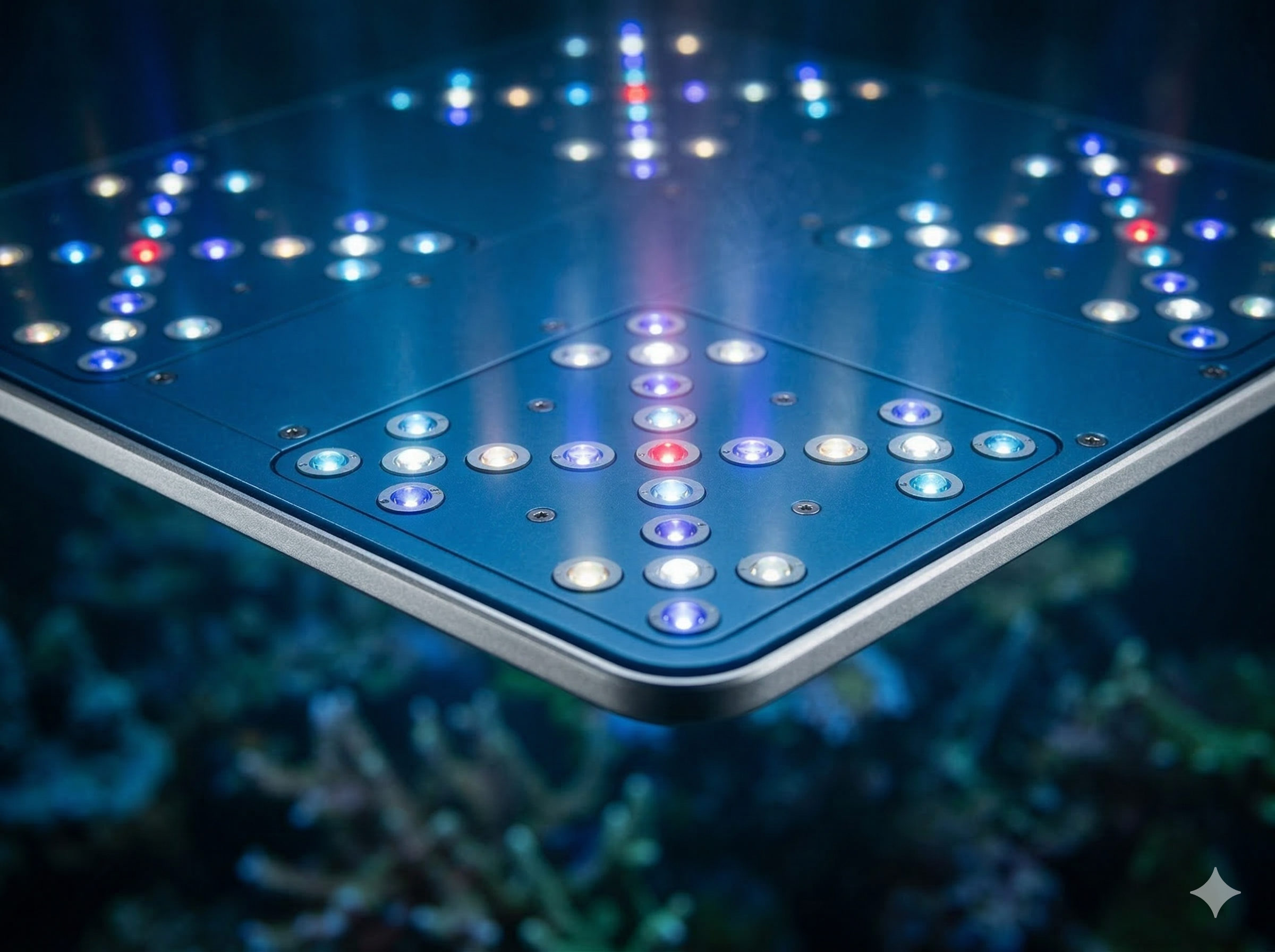
The Straton X is the culmination of this journey. Unlike many competitors that rely on concentrated clusters and powerful lenses to achieve high PAR (Photosynthetically Active Radiation) numbers, the Straton X uses a large-surface LED array. This design mimics the coverage of multiple T5 tubes, ensuring that light reaches the corals from multiple angles, which is critical for reducing self-shading in large SPS (Small Polyp Stony) colonies.
Technical Specifications: A Deep Dive into the Hardware
The Straton X distinguishes itself with a physical profile that challenges the industry’s limits. Measuring just 9 mm in thickness, it is one of the slimmest high-performance fixtures ever produced. This thinness is not merely for aesthetics; it is a testament to the thermal engineering of the full-aluminum housing.
Physical Dimensions and Build Quality
- Dimensions: 364 x 364 x 9 mm
- Weight: Approximately 2,500 g
- Housing Material: High-grade aluminum, powder-coated in Galaxy Grey.
- Cooling System: 100% passive (fanless). The entire housing acts as a heat sink, ensuring silent operation and eliminating a common point of mechanical failure.
Power and Efficiency
The Straton X is designed to deliver maximum usable light per watt. While many fixtures waste energy through heat or light spill, the Straton X focuses its output directly into the water column.
- Maximum Power Consumption: 150 W (Output) / 160 W (Input).
- Relative Performance: 2.6 PAR per Watt. This metric is vital for hobbyists looking to minimize electricity costs while maintaining high-light-demand organisms.
The Optical System: Reflectors vs. Lenses
One of the most significant design choices in the Straton X is the total absence of traditional lenses. Instead, the fixture utilizes 100 individual high-performance reflectors, one for each LED.
Anti-Glare Technology
Standard LED lenses often create “light spill,” where light escapes into the room, causing glare for the observer. The Straton X’s reflectors are recessed and flush-mounted, directing the light strictly downward into the aquarium. This creates a cleaner visual experience in the living room and increases the efficiency of the light reaching the corals.
Soft Shadow Technology
The distribution of these 100 LEDs across a wide surface area produces what ATI calls Soft Shadow Technology. In a typical “point source” LED (like a Kessil or a compact Radion), a single branch of a coral can cast a hard shadow on everything beneath it, leading to tissue recession. The Straton X provides light from such a broad range of angles that shadows are diffused and softened, much like the light on a reef under a tropical sun.
Spectrum and LED Configuration: The 7-Channel Hybrid Reef Spectrum
The Straton X is engineered as a true full-spectrum reef light. It doesn’t just provide “blue” or “white”; it offers a nuanced blend of seven different LED types to cover the entire photosynthetic range while enhancing the visual fluorescence of corals.
| LED Type | Count | Primary Benefit |
| UV (405 nm) | 8 | Stimulates green fluorescent pigments. |
| Violet (420 nm) | 8 | Provides PUR (Photosynthetically Usable Radiation). |
| Royal Blue (450 nm) | 20 | High PUR; enhances green and red fluorescence. |
| Blue (470 nm) | 28 | Boosts color diversity and overall growth. |
| Cyan White | 16 | Highlights pocilloporins and adds natural depth. |
| White | 16 | Provides natural brightness and high visual clarity. |
| Red (625 nm) | 4 | Enhances red tones and visual contrasts. |
Note on Application: The Straton X is currently optimized for Marine/Reef environments. While the older Straton Pro series offered specialized “Freshwater” versions, the Straton X focuses on the “Hybrid Reef Spectrum.” For freshwater planted tanks, the spectrum can be adjusted via the app, though the low red LED count (4) makes it less specialized for high-tech “Dutch Style” aquascapes compared to dedicated freshwater units.
Performance Metrics: PAR and Coverage
ATI has moved away from vague marketing claims, providing transparent data for planning. For the Straton X, two key areas have been defined to help users determine the number of fixtures needed.
SPS 200 Area
For demanding SPS corals, a minimum of 200 µmol/m²/s (PAR) is recommended. A single Straton X achieves this over a diameter of 85 cm when positioned 60 cm from the measurement point (usually 30–40 cm below the water surface).
LPS 100 Area
For LPS and mixed reefs, where 100 PAR is sufficient, the coverage extends to a 100 cm diameter. This massive spread allows a single unit to effectively light a standard 3-foot (90 cm) or even a 4-foot (120 cm) tank, depending on the coral placement.
Controlling the Straton X: The ATI Reef Pilot App
Modern lighting requires modern control. The Straton X utilizes the ATI Reef Pilot App, available for both iOS and Android. It offers several modes of connectivity to suit different home network setups.
Connectivity Options
- Access Point Mode: The light generates its own Wi-Fi signal. You connect your smartphone directly to the “ATI_Straton_” network. This is useful for initial setup or if no home Wi-Fi is available.
- Client Mode: The light connects to your home router. This allows you to control the light from anywhere in the house without switching Wi-Fi networks on your phone.
Advanced Features
- Live Energy Monitoring: View the real-time power consumption of the fixture.
- Live PAR Display: The app estimates the PAR output based on your current intensity settings, aiding in coral placement.
- Acclimation Mode: Slowly increases intensity over days or weeks to prevent “light shock” when introducing new corals or replacing old fixtures.
- Professional Templates: Access lighting schedules used by successful coral farmers and public aquariums.
Installation and Mounting Options
The Straton X offers flexibility in how it is positioned over the tank. However, it is important to note that mounting hardware is typically sold separately to allow users to choose the best fit for their setup.
The Straton X Mounting Arm
The most popular option for rimless tanks is the aluminum mounting arm. It features integrated cable routing, where the power cable is hidden within the arm itself, maintaining the ultra-clean look of the system.
- Adjustability: Height and depth are both adjustable.
- Compatibility: Fits glass thicknesses from 8 mm to 19 mm.
The Hanging Kit
For larger systems or those with multiple units, the Y-cable stainless steel hanging kit allows the lights to be suspended from the ceiling or a wall bracket. This provides a “floating” appearance and makes it easier to perform maintenance on the tank without moving the lights.
Comparison: Straton X vs. Straton Pro vs. Straton Flex
| Feature | Straton X | Straton Pro 102 | Straton Flex |
| Thickness | 9 mm | ~12–14 mm | Linear profile |
| LED Count | 100 | 102 | Varies (51/102/153) |
| Reflectors | Enhanced G3 Reflectors | Standard Reflectors | Reflectors |
| Cooling | 100% Passive | Passive/Hybrid | Passive |
| Best For | Maximum Spread & Silence | Raw Power | Long/Linear Tanks |
The Straton X is essentially the “MacBook Air” of the lineup—it is thinner, lighter (2.5 kg vs 3.8 kg+), and more efficient, yet it covers a larger area more evenly than its predecessors.
Verdict: Who is the Straton X for?
The ATI Straton X is designed for the advanced reef hobbyist who values three things: silence, minimalist design, and optimal coral health. It is not the cheapest light on the market, but its PAR-to-Price ratio and energy efficiency make it a cost-effective long-term investment.
Its ability to provide a T5-like spread without the need for bulb replacements or noisy cooling fans makes it a top-tier choice for modern reef keeping. While it is primarily a marine light, its spectral flexibility allows for experimentation in other aquatic environments, though its heart belongs to the coral reef.