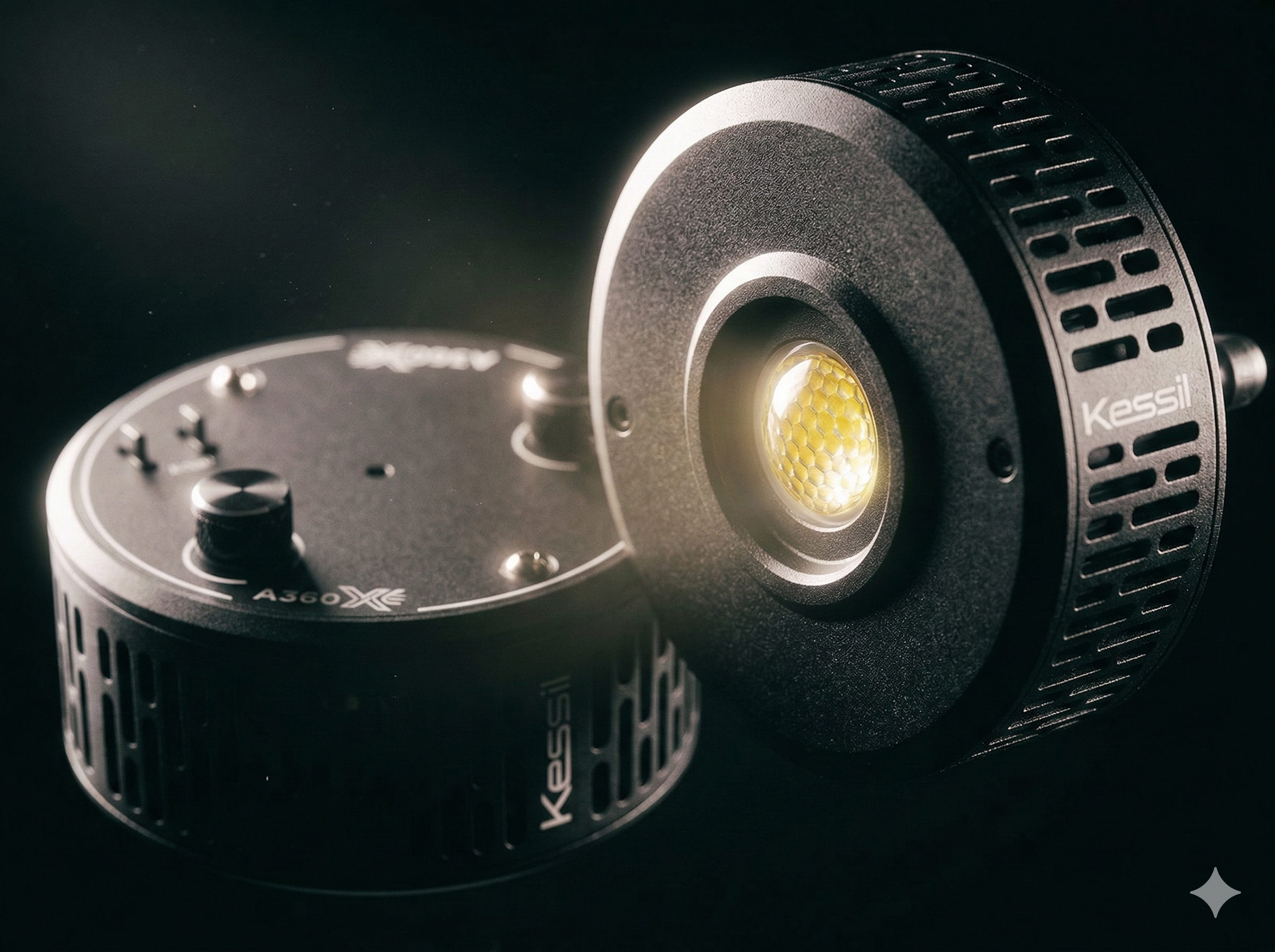
Aquarium lighting has transitioned from simple illumination to a complex science of photon management. The Kessil A360XE Tuna Sun sits at the pinnacle of this transition, offering a point-source light that mimics the sun’s natural intensity and shimmer. Unlike traditional LED strips that create a “flat” look, the A360XE utilizes a Dense Matrix LED array to provide depth, shadow, and life to freshwater ecosystems.
1. The “E” Evolution: What’s New in the A360XE?
The A360XE (where “E” stands for “Enhanced” and “Efficient”) is the direct successor to the industry-standard A360X. While the silhouette remains familiar, the internal engineering has been overhauled to deliver 15% more light output while maintaining the same 90-watt power draw.
Key Enhancements Over the A360X:
- Photon Volume Density (PVD): The LED chips are packed even tighter than before. This results in a more uniform beam and virtually eliminates the “disco ball” effect where different colors separate in the ripples.
- Flicker-Free Dimming: New circuitry ensures that even at 1% intensity, the light remains constant. This is crucial for high-speed videography and, more importantly, reduces stress on sensitive fish species.
- Improved Thermal Management: A redesigned “sunflower” heat sink increases the surface area for cooling, allowing the internal fan to run more quietly while extending the lifespan of the LED diodes.
- Refined Communication: The K-Link system has been hardened for better stability when daisy-chaining dozens of units in large gallery setups.
2. Spectrum and Color Science: The Tuna Sun Logic
The A360XE Tuna Sun is specifically engineered for freshwater environments, distinguishing it from the “Tuna Blue” saltwater version. Its primary spectrum ranges from 6,000K to 9,000K, simulating the shift from early morning sun to high-noon tropical light.
Beyond the Kelvin Scale
While the primary knobs control intensity and the white-to-yellow balance, the A360XE hides additional “hidden” channels that can be unlocked via the Kessil WiFi Dongle or Spectral Controller X:
- Red Channel: Specifically targets Chlorophyll a and b, which are vital for the growth of red plants like Rotala rotundifolia ‘H’Ra’ or Ludwigia palustris.
- Amber Channel: Adds warmth and increases the CRI (Color Rendering Index) for wood-heavy hardscapes, making driftwood look rich and textured.
- Burnished Yellow: Enhances the natural glow of fish scales, particularly on Discus and Cichlids.
Kessil Logic™ ensures that regardless of how you adjust the color, the light always maintains a balanced output of photosynthetic energy. You cannot “break” the spectrum in a way that would harm your plants.
3. Optical Performance and Coverage
One of the most common mistakes in aquascaping is underestimating the “shadowing” caused by dense plant canopies. The A360XE addresses this with its native 130-degree beam angle.
Coverage Specifications
| Setup Type | Recommended Coverage | Ideal Mounting Height |
| Moderately Planted | 24″ x 24″ (60 x 60 cm) | 8″ – 12″ above water |
| Heavily Planted (High-Tech) | 20″ x 20″ (50 x 50 cm) | 6″ – 8″ above water |
| Deep Tanks (30″+) | 18″ x 18″ with Narrow Reflector | 10″ above water |
The Power of Penetration
The A360XE can penetrate water up to 30 inches deep. For extra-deep tanks or “Dutch Style” setups requiring intense light at the substrate for carpeting plants like Hemianthus callitrichoides ‘Cuba’, the Narrow Reflector (sold separately) can be magnetically snapped onto the lens. This focuses the beam, increasing intensity by up to 3x at the bottom of the tank.
4. Control Ecosystem: K-Link and WiFi
The A360XE does not have built-in WiFi. This is a deliberate design choice by Kessil to keep the unit compact and to prevent internal heat from interfering with sensitive wireless chips. Instead, you have three distinct ways to control the light:
Manual Control
Two tactile knobs on the top of the unit allow for immediate adjustment of intensity and color. This is ideal for simple setups where a basic timer is used on the power outlet.
Kessil Spectral Controller X
This wired remote allows you to program “Quick Curves” to simulate sunrise, midday peaks, and sunset. It uses a USB-C (K-Link) cable to transmit data.
Kessil WiFi Dongle
The dongle plugs into the K-Link port and allows for full app-based control via iOS or Android. Through the app, you can:
- Create custom 24-hour schedules.
- Adjust individual Red and Amber color channels.
- Set an Acclimation Mode to prevent algae blooms or plant melt when introducing a new, powerful light to an established tank.
- Simulate weather patterns like “Cloud Cover” or “Lunar Cycles.”
Pro Tip: If you are using multiple A360XE units, you only need one WiFi Dongle or Spectral Controller. You can link the remaining lights using K-Link cables, and they will follow the “Master” unit’s instructions.
5. Integrating the A360XE into Your Aquascaping Workflow
The A360XE is a “Point Source” light. This means it creates strong shadows and a distinct shimmer. Understanding how to use this is key to a professional-looking aquarium.
Managing the Shimmer
The shimmer is caused by the light refracting through surface agitation. If the shimmer is too intense, reduce the surface flow or raise the light. If you want more shimmer, use a lily pipe or a surface skimmer to create ripples directly under the LED.
Avoiding Algae with High Intensity
At 90 watts, the A360XE is extremely powerful. In a tank without CO2 injection, running this light at 100% will likely lead to Brush Algae (BBA) or Staghorn Algae. It is recommended to start at 40% intensity and increase it by 5% every week as your plant mass grows.
Hardscape Considerations
Because the light comes from a single point, large pieces of driftwood or stones can create “dead zones” of shadow. To combat this, you can:
- Use two A360XE units angled slightly toward each other.
- Place low-light plants like Anubias or Bucephalandra in the shaded areas.
- Mount the light higher to allow the 130-degree beam to “wrap” around objects more effectively.
6. Technical Specifications Table
| Feature | Specification |
| Dimensions | 4.3” x 2.1” (11cm x 5.3cm) |
| Weight | 0.81 lb (0.37 kg) |
| Spectrum | 6,000K to 9,000K + Red + Amber |
| Max Power Draw | 90W (19V DC Output) |
| Voltage | 100-240V AC (Input) |
| Communication | K-Link (USB-C) and 0-10V |
| Cooling | Active (Internal Fan) |
| Mounting | Hanging Ring included (Arm/Gooseneck optional) |
7. Installation and Maintenance
The A360XE is designed for longevity, but like all high-output electronics, it requires basic care.
Mounting Options
- A-Series Mounting Arm: The most aesthetic option, providing a clean “floating” look over the tank.
- Gooseneck: Offers flexibility for smaller or oddly shaped rimless tanks.
- Hanging Kit: Ideal for large galleries where lights are suspended from the ceiling.
Maintenance Schedule
- Monthly: Use a can of compressed air to blow dust out of the “sunflower” venting holes. Keeping the fan clear is the number one way to prevent premature LED failure.
- Quarterly: Clean the LED lens with a soft, dry microfiber cloth. If salt creep or mineral deposits (from evaporation) are present, use a slightly damp cloth with distilled water or isopropyl alcohol. Never spray cleaning agents directly onto the lens.
- Annually: Check the K-Link cables for any signs of corrosion, especially if they are located near a high-flow area where micro-bubbles might pop and spray water.
8. Final Verdict: Is it Worth It?
The Kessil A360XE Tuna Sun is an investment. It is positioned as a premium light for serious enthusiasts who prioritize aesthetics and plant health.
Pros:
- Unrivaled shimmer and natural light quality.
- Extremely compact and lightweight design.
- Sophisticated logic prevents “bad” color settings.
- 15% increase in PAR (Photosynthetically Active Radiation) makes it viable for the most demanding red plants.
Cons:
- WiFi and Mounting hardware are sold separately, increasing the total cost.
- The fan, while quiet, is audible in a completely silent room.
If you are aiming for a competition-level aquascape or a high-tech “Dutch” garden, the A360XE is arguably the best single-point LED on the market in 2026. Its ability to combine raw power with a delicate, natural spectrum makes it a tool that grows with your skill level.