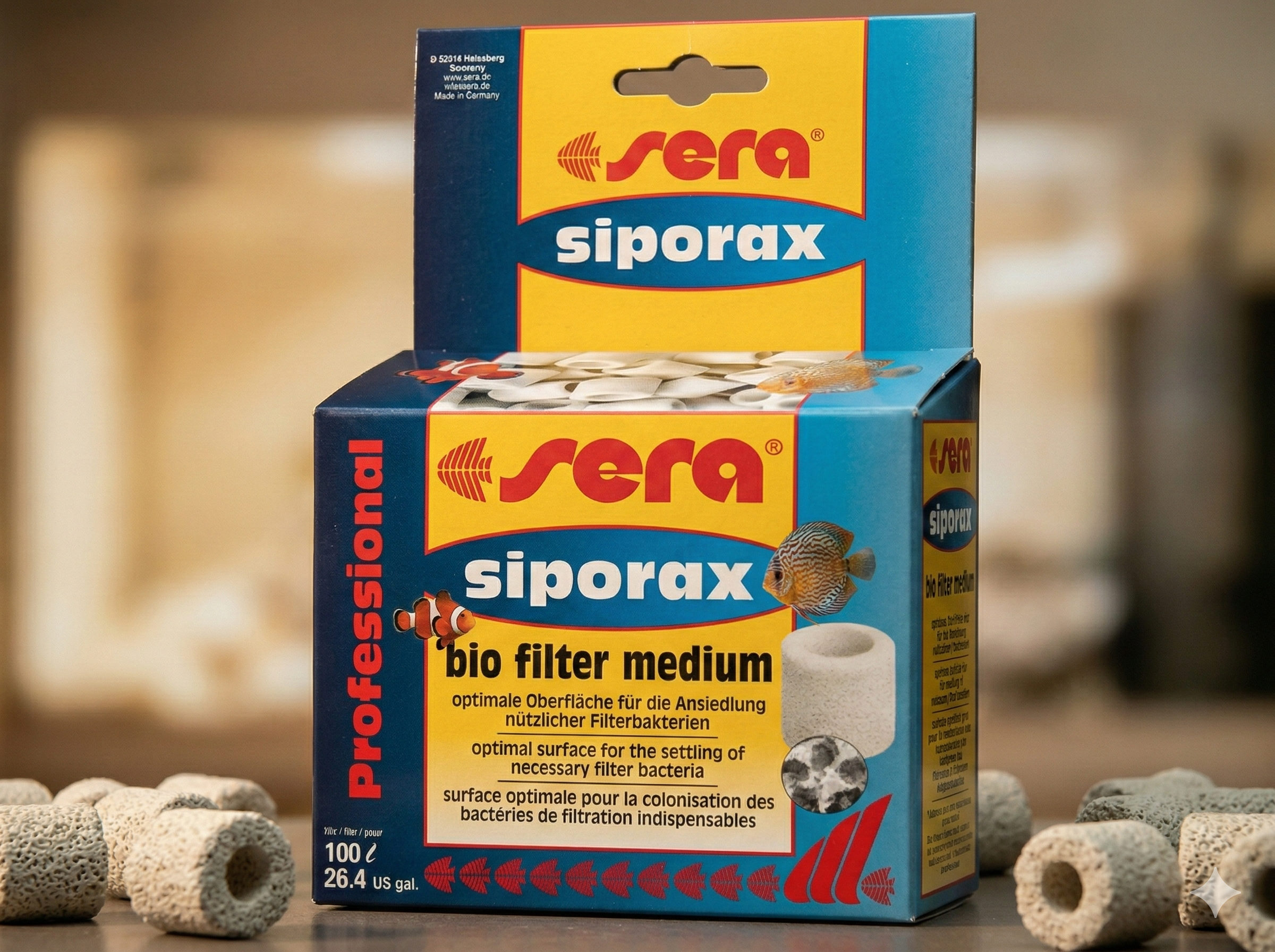
Biological filtration is the invisible heart of every successful aquatic ecosystem. Whether you are maintaining a delicate high-tech aquascape, a robust marine reef, or a high-stocking African Cichlid tank, the stability of your water parameters depends entirely on the surface area available to your beneficial bacteria. Among the plethora of filter media available on the market, sera siporax professional 15 mm has established itself as a benchmark for high-performance sintered glass media.
This article provides a technical and practical analysis of sera siporax, exploring its manufacturing process, biological mechanisms, and application across various aquatic environments.
1. The Engineering Behind the Media: Sintered Glass and Pore Structure
To understand why sera siporax performs differently than standard ceramic rings, one must look at the microscopic level. Most “ceramic” rings are manufactured using high-heat processes that result in a closed-pore structure; essentially, the surface is smooth and the internal volume is inaccessible to bacteria.
The Salt-Crystal Manufacturing Process
Sera utilizes a specialized, patented manufacturing process for siporax. It begins with a mixture of recycled glass powder and salt crystals of a precisely defined size. This mixture is pressed into the characteristic 15 mm ring shape and then “sintered”—fired at approximately 780 °C (1436 °F).
During this process, the glass particles fuse together around the salt. After firing, the rings are washed, dissolving the salt and leaving behind a vast, interconnected network of tunnels and pores. This “open-pore” structure is what sets Siporax apart.
Technical Fact: Because the salt crystals act as placeholders for the future pores, sera can precisely control the pore size to ensure it matches the physical dimensions of nitrifying bacteria, typically ranging from 0.5 to 2.0 microns.
Effective Surface Area vs. Theoretical Surface Area
In the aquarium industry, manufacturers often boast about “total surface area.” However, for a hobbyist, only the effective surface area—the area actually accessible to water flow and bacterial colonization—matters.
| Feature | sera siporax professional 15 mm | Standard Ceramic Rings |
| Material | Sintered Glass (Open-Pore) | Fired Clay/Ceramic (Closed-Pore) |
| Effective Surface | 270 m² per liter | ~30-50 m² per liter |
| Flow Dynamics | High (Internal & External) | Low (External only) |
| Nitrate Removal | Yes (in deep pore zones) | No (Aerobic only) |
2. The Multi-Stage Biological Process
Most filter media are designed solely for nitrification—the conversion of Ammonia (NH3/NH4) to Nitrite (NO2) and then to Nitrate (NO3). Sera siporax is engineered to go one step further by facilitating denitrification.
The Aerobic Zone (Outer Layers)
The outer surface and the walls of the larger tunnels in the Siporax ring are high-oxygen environments. This is where aerobic bacteria, such as Nitrosomonas and Nitrobacter, flourish. They consume the oxygen-rich water flowing through the ring to oxidize toxic ammonia and nitrite.
The Anaerobic Zone (Deep Pores)
Because the pore system in Siporax is three-dimensionally interconnected and reaches deep into the material, a gradient is created. As water travels deeper into the microscopic tunnels, the aerobic bacteria on the periphery consume the available oxygen.
This creates hypoxic (low-oxygen) zones in the center of the ring material. In these zones, anaerobic bacteria take over. These specialized microbes utilize the oxygen atom from the Nitrate (NO3) molecule for their metabolism, effectively breaking down Nitrate into harmless Nitrogen gas (N2), which سپس escapes the aquarium through the water surface.
3. Versatility: Freshwater, Marine, and Ponds
One of the primary advantages of sera siporax professional is its chemical neutrality. It does not affect the pH or water hardness, making it suitable for a wide variety of setups.
Freshwater Aquariums
In freshwater tanks, Siporax is often the “set-it-and-forget-it” solution for long-term stability.
- Aquascapes: Lowers the need for massive water changes by controlling nitrate buildup, which helps prevent opportunistic algae blooms.
- Discus & Cichlid Tanks: High-protein feeding leads to massive ammonia spikes. The high surface area of Siporax provides the biological “buffer” needed to process these loads instantly.
Marine and Reef Systems
In saltwater, the management of Nitrate is critical for coral health. While many reefers rely on “Live Rock,” sera siporax offers a more controlled, high-density alternative.
- Sump Application: Placing Siporax in a high-flow area of the sump ensures rapid nitrification, while placing it in a low-flow “passive” area can enhance its nitrate-removing anaerobic capabilities.
- Safety: It is completely reef-safe and does not leach phosphates or silicates (a common concern with lower-quality glass media).
Garden Ponds and Koi
For pond enthusiasts, the 15 mm “Professional” size is often used in smaller pressurized filters, while the larger “Pond Siporax” is used for massive gravity filters. However, the 15 mm variant remains excellent for pre-filtration stages or bead-style filters due to its superior surface-to-volume ratio.
4. Optimal Placement and Installation
To maximize the lifespan and efficiency of sera siporax, the order of filtration is paramount. Because the pores are microscopic, they can be “blinded” or clogged by physical detritus (fish waste, plant matter).
The “Triple-Stage” Filter Setup
- Mechanical Pre-filtration: Use filter wool, sponges, or “sera crystal clear” to trap large particles. This ensures that the water reaching the Siporax is free of solids.
- Biological Stage (Siporax): This is where the 15 mm rings reside. They should remain as clean as possible to maintain water flow through the internal tunnels.
- Chemical/Fine Polishing: If necessary, place activated carbon or fine synthetic resins after the Siporax stage.
Biological Activation
When first installing Siporax, the material is sterile. To “cycle” the filter faster, it is highly recommended to use a bacterial starter such as sera filter biostart.
- Step 1: Rinse the Siporax in a bucket of dechlorinated water to remove any glass dust from shipping.
- Step 2: Place it in the filter media basket.
- Step 3: Apply the bacterial starter directly onto the damp media before starting the filter.
5. Maintenance: Longevity and Cleaning
A common myth in the hobby is that biological media must be replaced every few months. With sera siporax professional, this is not only unnecessary but counterproductive.
Cleaning Guidelines
You should only clean Siporax when you notice a significant decrease in the filter’s flow rate.
- Never use tap water: The chlorine and chloramines in tap water will instantly kill the delicate bacterial colonies.
- The Bucket Method: Always rinse the media in a bucket containing water siphoned from the aquarium during a water change.
- The “Half-and-Half” Rule: If you have a large amount of media, clean only half of it at a time to ensure that the biological capacity of the tank remains stable.
When to Replace?
Sera siporax is extremely durable. However, over several years, the rings may slightly erode or the deepest pores may become permanently blocked by mineral deposits.
Observation Tip: If the rings feel “slimy” even after a rinse, or if your Nitrate levels begin to creep up despite consistent maintenance, it may be time to replace approximately 25% of the media with fresh rings.
6. Comparative Analysis: Siporax vs. Competitors
When choosing media, aquarists often weigh Siporax against Seachem Matrix or Eheim Substrat Pro.
Siporax vs. Seachem Matrix (Stone/Pumice)
- Shape: Matrix is stone-like and irregular; Siporax is a uniform ring.
- Flow: The ring shape of Siporax allows for a “tunnel effect,” reducing the chance of “dead spots” or filter clogging. Matrix can pack tightly, potentially slowing down flow in smaller canisters.
- Surface Area: Both offer high surface area, but Siporax’s open-pore structure is more scientifically documented regarding internal anaerobic zones.
Siporax vs. Ceramic Rings (Standard)
Standard ceramic rings are essentially mechanical media that happens to host a small amount of bacteria. Siporax is a dedicated biological powerhouse. Replacing standard ceramic with Siporax can increase your biological capacity by up to 34 times.
7. Troubleshooting and Common Questions
Q: Can I use Siporax in an internal filter? A: Yes. The 15 mm size fits in most medium-to-large internal filter cartridges. For very small filters, “sera siporax mini” is available, which offers the same technology in a smaller form factor.
Q: Why is my Nitrate not dropping? A: Denitrification (Nitrate removal) takes time to establish—often 3 to 6 months. Additionally, if your water flow through the filter is too high, oxygen may penetrate the entire ring, preventing anaerobic zones from forming. Ensure your stocking levels and feeding habits are balanced.
Q: Does Siporax leach Silicate? A: There are occasional reports in the hobby regarding silicates. However, high-quality sintered glass used by sera is processed to be extremely stable. In most cases, “silicate” issues in new tanks are actually caused by the tap water or the substrate, not the filter media.
Summary of Technical Specifications
- Diameter: 15 mm
- Effective Surface Area: 270 m² per liter
- Dosage: 1 liter of Siporax is sufficient for approximately 200 liters (50 gallons) of aquarium water.
- Compatibility: Freshwater, Saltwater, Pond.
- Included in Box: Often includes a mesh media bag for easy handling.
Conclusion
Investing in sera siporax professional 15 mm is an investment in the long-term health of your fish and plants. Its unique ability to handle the entire nitrogen cycle—from ammonia to nitrogen gas—within a single, compact ring makes it one of the most efficient media options on the market. By ensuring proper pre-filtration and avoiding chlorinated water during maintenance, a single liter of Siporax can provide a stable biological foundation for your aquarium for many years.